

I dedicate this essay to Macma student/seekers in year of 2002 -2004 as listed below: Steven Lee, Linda Tan, Loh Boon Lin, Nur Nadhira Tan, Yap Aik Chuan, Diana Ooi, CK Chow, Arif and Nur Hidayah Wong....
The Fuqara Must Ask For Change- By Shaykh Abdal Qadir as-Sufi
The du'a of the Muslim is, "O Allah, keep me in change." Keep me always changing because everything is changing and every day Allah is on a new creation.
You must be renewing and renewing yourself. You have to always be in change. You must remember that the company of the fuqara is the highest company. You must keep each other company. You must travel to other places where there are fuqara. You must sit with the fuqara in every place. You must be an example to them and take example from them when you meet people of quality. Seek the people of knowledge, seek the people of love of Allah, subhanahu wa ta'ala, and the people of love of Rasul, sallallahu `alayhi wa sallam. To take the adab of the great ones you have to sit with them, you have to sit with the people of knowledge. It is by your company that you are purified.
Tasawwuf is keeping company, then tasawwuf is listening, then tasawwuf is acting upon what you hear. There is only one enemy and that is your self. The nafs has nothing good in it. The worst of all things to the Sufis is the recognition of their own good qualities over and against that of other people – it is what sets them back and smashes them on the rocks of destiny. You must not look at your good qualities. You must consider them something that in themselves have been spoiled even by your being conscious of them. You do not look at your self.
You do not find fault with others, you find fault with your self.
You must look at your self and say, "What is wrong with it?" Harith al-Muhasibi went over his day, then went over his hours and then went over his minutes, then went over his breath until he had verified that it was pleasing to Allah, that it was acceptable to Allah. Two great `ulama met in Baghdad and they argued and fought with each other. At the end one of them said, "Let us meet tomorrow and discuss this matter further and the other one said, "No, let us meet tomorrow and make peace and forget all about it."
This is the way of the Sufis – to begin again.
You must not be limited in your forgiveness of the faults of others but you must not have any measurement of any attention to yourself. Any consciousness of your self you must turn from. You must turn away from the nafs and the method of turning away from the nafs is not a psychological method, it is dhikrullah. (Surat ar-Ra'd, 28 ) "Only in the dhikr of Allah can the heart find peace." You must do dhikr of Allah. You must remember Allah standing, sitting and reclining on your side. You must call upon Allah. You cannot afford to be out of the company of the people who love Allah for any amount of time in this age that we live in. You must be with the people who love Allah, you need them. You need the people of Allah because they will remind you of Allah. You need the people of knowledge because you have to be strong in your Deen and you have to be correct in your Deen in an age where every mosque has a different way of going into sajda, let alone the higher things of the Deen.
You must speak well of people and have a good opinion of people. You must become people of futuwwa, you must become these people who are spoken of because of the high aspiration, the high himma you have which is on a universal scale that when you go to the Ka'ba, with all the troubles that are there, you must lookfor the people of Allah there and sit with them. Beware of the people of dunya. Beware of the people of dunya until you are safe, and when you are safe it does not matter where you go. If you are not safe then you must be careful. You must have taqwa and you must have wara'. You must take care, take care, watch, until you are on Sirat al-Mustaqim because when things go wrong you have to remember that all you have got is then to turn to Allah, subhanahu wa ta'ala.
Remember, even tawba is nothing to do with you – it is because Allah has decreed for you tawba because He wants you, so even that is not yours, it is not your good achievement.
Your asking forgiveness is not your good achievement, it is simply Allah claiming you and you recognising that He has claimed you. You belong to Allah. You have come from Allah and you are going to Allah. This is what you have to tell yourself. You must not be hypnotised by dunya.
Remember that Rasul, sallallahu `alayhi wa sallam, indicated that the small coin of the poor person is as dangerous as the gold of the rich, so you must be generous. To be generous is to follow the way of Rasul, sallallahu `alayhi wa sallam. You must be generous, you must have a good opinion of other people, you must not say bad things about other people and if you do say them you must go back and clean it out and you must ask their forgiveness. If someone is totally against you and totally in the wrong then you have to forgive them and you have to forget it and you have to go back and put things right. This is how the Deen has always been. This is how these great men have lived in the past.


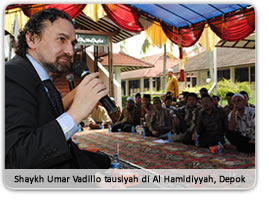 Nama Shaykh Umar Ibrahim Vadillo mulai dikenal luas di dunia internasional pada awal 1990an. Ini dimulai ketika ia, sebagai pemuda berusia 28 tahun, mencetak kembali koin Dinar emas dan Dirham perak di Granada, Spanyol, pada 1992. Tindakan ini ia lakukan sebagai konsekuensi dari terbitnya Fatwa Haramnya Uang Kertas sebagai Alat Tukar yang ia terbitkan setahun sebelumnya, 1991. Fatwa itu sendiri ia terbitkan sesudah beberapa tahun mempelajari secara mendalam persoalan muamalat dan riba dalam syariat Islam.
 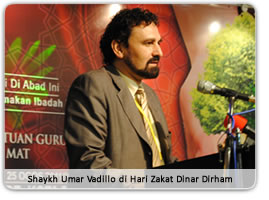 Sekitar sepuluh tahun kemudian, krisis moneter sejenis kembali terjadi, kali ini di jantungnya sendiri yaitu di AS dan Eropa. Dimulai pada akhir 2008, dengan persoalan gagal bayar pada kredit perumahan di AS, yang diikuti dengan kebangkrutan beberapa perusahaan finansial, seperti Lehman Brothers, dunia terus dibayangi bencana keuangan global. Sampai lewat pertengahan 2010 krisis keuangan di Eropa, dengan pusatnya di Yunani dan mulai menular ke Spanyol dan Portugal, membuka mata dunia akan kebenaran segala yang disampaikan oleh Shaykh Abdalqadir sejak dua tiga dekade lalu. Pengenalan kembali Dinar dan Dirham pun semakin luas diterima.
 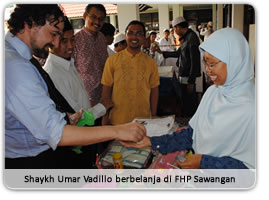 Selain Dinar dan Dirham yang kini mulai diterapkan di mana-mana Shaykh Umar menghadirkan sejumlah pengetahuan kepada kita melalui berbagai karya tulisnya, baik berupa buku, risalah, artikel, maupun naskah pidato. Dua buku yang ia tulis pada awal 1990an adalah The End of Economics (1991), kemudian The Return of Islamic Gold Dinar (1996), dua judul buku yang merefleksikan perjalanan perjuangannya. Pada tahun 2003 sebuah bukunya yang lain, setebal hampir 1000 halaman, The Esoteric Deviation in Islam, diterbitkan. Buku ini membedah penyakit yang diderita oleh sebagian kaum muslimin sendiri, yang dalam kurun lebih dari 150 tahun belakangan ini, mengambil jalan yang keliru, yakni mengasimilasikan Islam kedalam kapitalisme.
 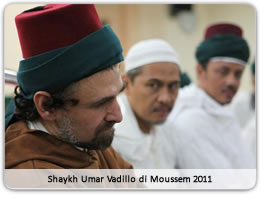 Menjelang akhir 2006 Shaykh Umar kembali mengeluarkan sebuah fatwa penting, Fatwa on Banking and the Use of Interest Received on Bank Deposits (Fatwa tentang Perbankan dan Penggunaan Bunga Deposito). Ini adalah sebuah dokumen fatwa setebal 66 halaman ia tulis dengan cukup komprehensif. Fatwa ini memberikan panduan yang jelas atas kebingungan umat Islam dalam kenyataan sehari-hari yang masih tidak lepas dari urusan dengan sistem riba, yakni sistem perbankan. Terakhir, sebagai bagian dari yang ia lakukan di Kelantan, pertengahan 2010, Shaykh Umar kembali menulis sebuah fatwa, yakni tentang zakat, berjudul Fatwa on the Payment of Zakat: Using Dinar and Dirham the Issue of Ayn and Dayn in Zakat.

